

A scientific tool to enhance inclusiveness and adoption of digital solutions for agrisystems
The Multidimensional Digital Inclusiveness Index (MDII) shows researchers and innovators how to make a digital solution more inclusive.
External evaluators score the solution against 90 indicators of inclusiveness and deliver actionable insights to improve adoption by a wider range of users.
MDII is built for agrisystems. It surfaces the gender, socioeconomic, technological and location-specific barriers that keep farmers in the global South from adopting digital tools.
Teams building digital solutions for agrisystems in the global South: farm advisories, decision support platforms, sensors, marketplaces.
Domain experts, field teams and research partners who run evaluations with users and beneficiaries, online or offline.
Decision makers who need evidence on which digital tools reach women, youth and other underrepresented groups, and what it takes to close the gaps.
Click the + sign to open each section.
An MDII evaluation can start at any point in the life of a digital tool, from early concept to deployment. Tools still in design take the Ex-Ante version, which anticipates inclusiveness issues before scale. Tools already in users’ hands take the Regular version, which draws on feedback from real users. The first step is to choose the type of assessment you need.

Request
Innovators or developers request an evaluation. A coordinator scopes the tool, identifies users and beneficiaries, and plans the fieldwork.

Collect
Evaluators gather qualitative and quantitative evidence: surveys and interviews with users and downstream beneficiaries, and scoring by domain experts.
Receive
The MDII ecosystem computes the scores and delivers the inclusiveness report and a prioritised set of recommendations, then presents the findings back to your team.
An AI assistant collects what it needs from the innovator in one chat session. No fieldwork.
The answers are processed automatically and a preliminary inclusiveness reading is sent to you by email.
Use the reading to improve early, and to decide whether a full evaluation is the next step.
Evaluations can also run offline with the desktop toolkit, for field conditions where connectivity is unreliable.
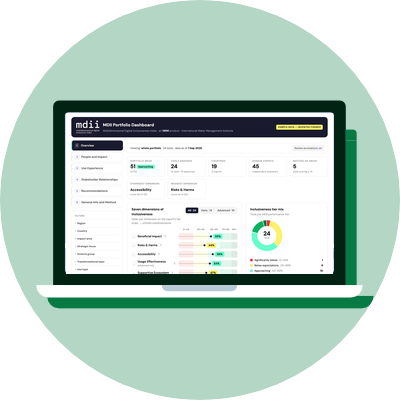
Every evaluated tool receives a report and a private dashboard, where its team can explore scores by dimension, subdimension and indicator, and track the recommendations.
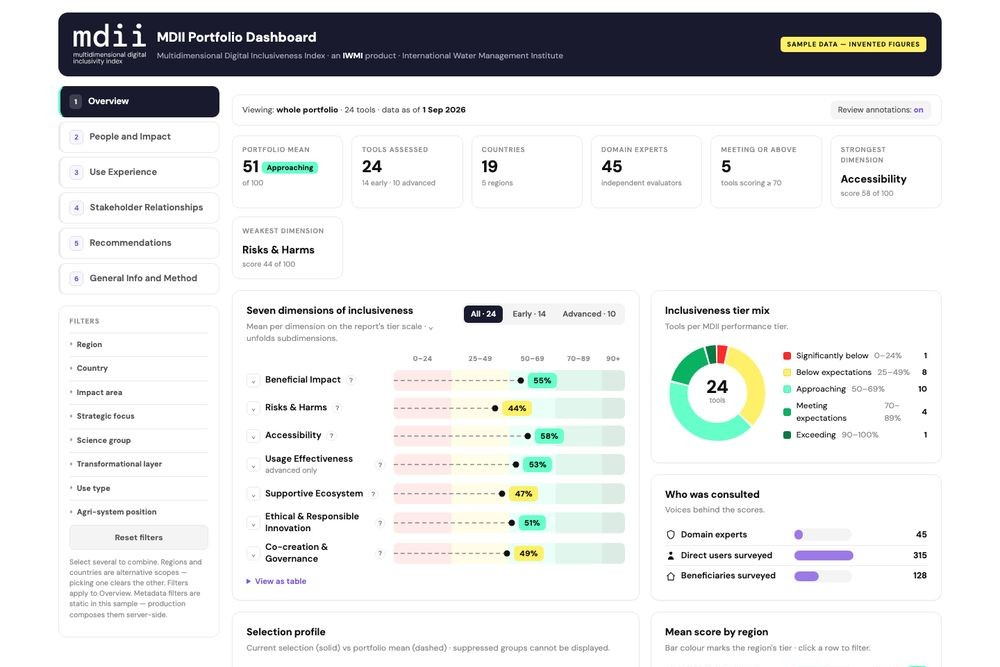
Across all evaluations, a public portfolio dashboard shows how inclusive digital agriculture tools are today, by region, dimension and user group, without naming any tool.
MDII is a structured evaluation framework that treats inclusiveness as a core requirement throughout the life of a digital innovation. It assesses whether a tool is accessible, usable, ethically sound and supportive of diverse users, especially those most often excluded from the benefits of technology.
Evidence comes from surveys of direct users and downstream beneficiaries, usability testing, stakeholder interviews, scoring by domain experts and a review of the tool’s documentation. On that evidence, the evaluation team writes recommendations tailored to the tool’s maturity, user context and implementation environment.
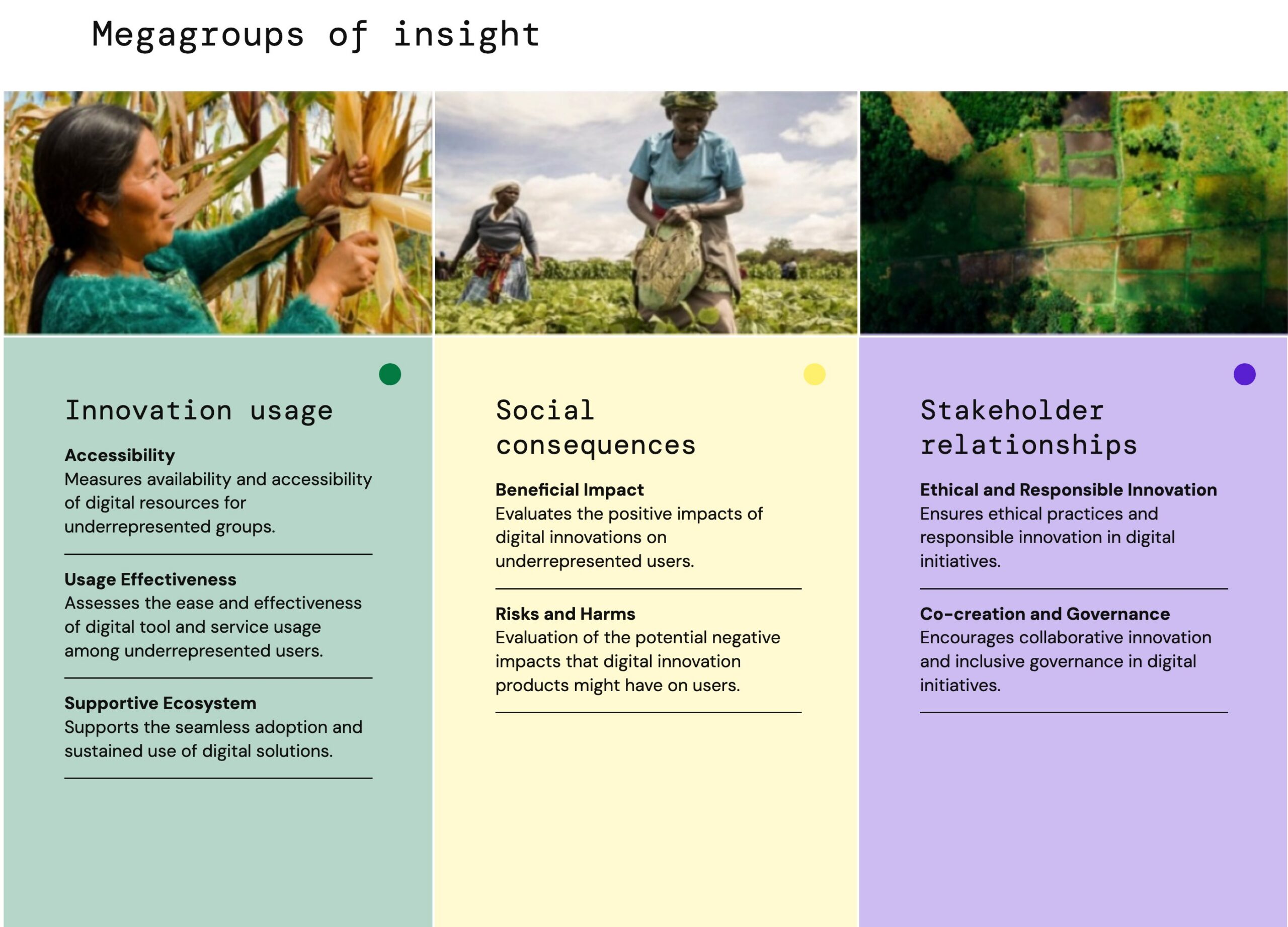
The framework groups 90 indicators into 27 subdimensions and seven dimensions, under three mega-groups: Innovation Usage (Accessibility, Usage Effectiveness, Supportive Ecosystem), Social Consequences (Beneficial Impact, Risks and Harms) and Stakeholder Relationships (Ethical and Responsible Innovation, Co-Creation and Governance).
How the MDII framework is organised. Click an arc to explore the dimensions, subdimensions and indicators.
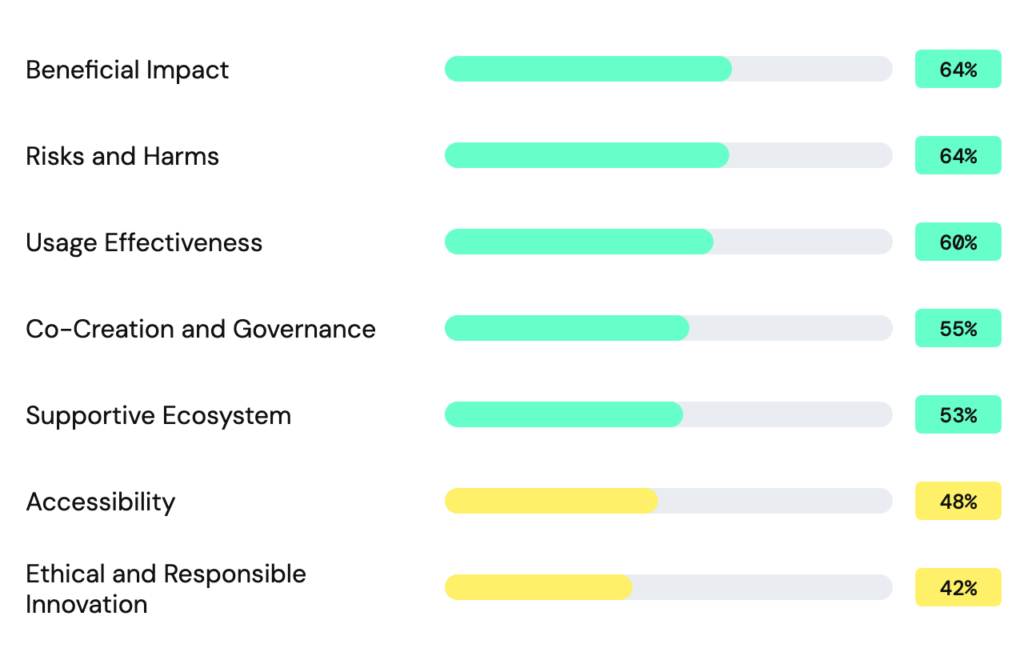
Each dimension and subdimension receives a score on a five-tier scale, so strengths and gaps are easy to see. All dimensions and indicators carry equal weight.
Based on the scores, domain expertise and stakeholder input, the evaluation team provides recommendations and actionable insights for improvement.
Research into digital inclusion highlights the importance of individual experiences in technology adoption processes. Understanding if (and how) digital agritools are inclusive requires examining not only structural aspects, such as access to technology, but also the experiential dimensions.
The term digital inclusiveness encompasses both dimensions: a structural aspect (“inclusion”), concerned with access and opportunity, and an experiential aspect (“inclusivity”), focused on users’ sense of belonging and engagement.
Metrics and methods are essential for assessing inclusiveness and transformative impact, especially in identifying populations historically excluded from digital innovations. However, existing indices are limited in scope and not adapted to agri-food system applications.
MDII addresses this gap by integrating concepts from both Information Systems (IS) theory and gender equality and social inclusion (GESI) research to assess not only whether digital technologies are available and accessible, but how they are experienced, adopted, and governed by diverse agricultural actors.
Opola, F., Langan, S., Arulingam, I., Schumann, C., Singaraju, N., Joshi, D., Ghosh, S. (2025).
Martins, C. I., Opola, F., Jacobs-Mata, I., Garcia Andarcia, M., Nortje, K., Joshi, D., Singaraju, N., Muller, A., Christen, R., Malhotra, A. (2023).
MDII applies to digital solutions in agrisystems anywhere in the world. Click a country to see where it has been used.
Across the digital innovations evaluated so far (17 tools in 14 countries as of September 2026), MDII assessments show recurring patterns in what makes a digital tool inclusive, and what gets in the way.
The most critical gaps often sit outside the scope of a conventional technical assessment: affordability and predictable costs for users, formal ethical oversight, impact assessment and the governance of data. Tools whose teams took deliberate gender and inclusion actions scored higher on every dimension.
Many recommendations are simple and low-cost: offline functionality, plain-language guidance, shared FAQs and worked examples, better training material. Others are strategic: data governance frameworks, transparent algorithms, and designs that adapt to the infrastructure of each setting.
Digitisation of agrifood systems can widen the digital divide, and even well-designed tools struggle to reach a diverse range of users in the global South. MDII gives developers, evaluators and funders a shared way to see who a tool serves, and what to change.
To assess your tool, start with a rapid or a full assessment. For everything else, write to mdii@cgiar.org.
Start the process with either a rapid or a full assessment
Contact mdii@cgiar.org for detailed enquiries.